News Story

Once upon a time… is a phrase we all know. Used to introduce children to the wonders of storytelling and fairytales in particular, for centuries. But one of the most famous fairy tales of all, Sleeping Beauty is much older, much stranger (and at times disturbingly sinister) than the version most of us grew up with.
Long before princesses in sequinned gowns, handsome princes and magical castles became staples of the Christmas pantomime, stories of enchanted sleep, cursed women and mysterious spells were being told and retold across Europe.
So where did Sleeping Beauty actually come from and how did this centuries-old fairy tale become one of the great pantomime favourites?
A story with very deep roots
It seems that there isn't a single defined moment when the story of Sleeping Beauty was invented. Like many fairy tales, it evolved from earlier stories and oral traditions, changing as it travelled between countries, writers and generations.
One of the earliest recognisable versions appears in the 14th century medieval French romance Perceforest. It features a princess named Zellandine who falls into an enchanted sleep after encountering a spindle… Sound familiar?
A more developed version appeared centuries later in Italy. In the 1630s, writer Giambattista Basile published Sun, Moon and Talia. It contains many of the ingredients modern audiences would recognise. A sleeping princess, a piece of flax becoming lodged in her finger and an enchanted sleep, but it's considerably darker than the fairy tale we know today.
Really, REALLY dark, in fact.
The story contains themes of violence, abuse, adultery and attempted cannibalism (I won’t be adding it to my ‘to read’ pile any time soon). So, not an ideal choice for a family Christmas show!

Enter stage left… Charles Perrault
The story took a (thankfully) significant step towards the version we recognise today in 1697, when French writer Charles Perrault published La Belle au bois dormant, usually translated as The Sleeping Beauty in the Wood.
Perrault's version softened some of the darker elements of earlier tellings, while introducing many features that would become central to the story. His Sleeping Beauty falls into a hundred-year sleep after pricking her finger, and a prince eventually arrives at the castle.
But, like any good story… there's a twist: Perrault's story doesn't actually end with the famous kiss.
After the princess wakes, the story continues into a second part involving her marriage, her children and a rather terrifying ogre mother-in-law. It's considerably more dramatic than the neat “happily ever after” ending we might expect today.


Happy ever after that kiss
The version that helped establish the ending we know today came from another famous collection of fairy tales.
In 1812, the Brothers Grimm published their version, Little Briar Rose. Their story is shorter and considerably tamer. Most importantly, it ends with the princess being awakened by the prince's kiss. Still not an ideal ending by modern standards of consent but at least moving in the right direction and far away from 14th Century France.
So, despite the fact that we often think of the kiss as an essential part of the original Sleeping Beauty story, it actually arrived relatively late in the tale's history. Which is actually one of the wonderful things about fairy tales: there often isn't one definitive version. From a dark medieval romance down the centuries to Disney, stories like Sleeping Beauty change, adapt and pick up new details as they are retold.

From fairy tale to theatrical spectacle
So how did Sleeping Beauty make the leap from the pages of fairy-tale collections to the festive stage? The answer lies in the history of British pantomime itself.
The pantomime we know today developed from a mixture of traditions, including Italian Commedia dell'Arte, which brought stock characters, physical comedy, music and improvisation to European stages.
By the 18th century, these traditions were being combined with stories from classical mythology and popular tales on the British stage. Over the following century, pantomime evolved into the flashy, comic and interactive form we know today. And for this… fairy tales were perfect material.
They offered everything a panto needed: magic, villains, heroes, transformations, larger-than-life characters, lovely scenery and plenty of opportunities for things to go hilariously wrong.
By the Victorian era, pantomime had become a huge Christmas tradition, with elaborate sets, costumes, special effects and increasingly spectacular productions.


Sleeping Beauty's big panto moment
One particularly spectacular milestone came at London's Theatre Royal, Drury Lane at Christmas 1900. That year's pantomime was The Sleeping Beauty and the Beast, combining Sleeping Beauty with Beauty and the Beast into one enormous theatrical extravaganza.
It featured multiple magical locations and its grand finale was an elaborate transformation scene involving a grand staircase and real-life fountains. I can hear our Buildings and Operations Manager rustling his risk assessment papers in sheer terror at the thought.
By now, Sleeping Beauty wasn't simply being presented as a fairy tale. It was being turned into spectacle. The kind of big, magical theatrical experience that audiences could come together to enjoy at Christmas. And that tradition has stuck.
Perhaps Sleeping Beauty feels particularly at home in pantomime because the story already contains so many of the ingredients that make panto brilliant.
There's a spectacular world
There's a villain to boo
There's a hero to cheer
There's magic, music, comedy and chaos
There's a curse that needs breaking and a castle that needs saving
And, of course, there's an audience who can become part of the story
Because while the Sleeping Beauty of 1697 might not have expected a room full of people shouting “He's behind you!”, pantomime has always been about taking familiar stories and making them feel new again. More than 300 years after Perrault published his version, we're still gathering together to watch this princess wake from her enchanted sleep.
The details may have changed. The jokes may have changed. The costumes, music and special effects certainly have. But the basic magic remains.

Once upon a time and happily ever after
Of course, there isn't really one version of Sleeping Beauty anymore. There are fairy tales, ballets, films, books, musicals and pantomimes. The story has been continually reinvented to reflect the people telling it and the audiences watching it and our retelling is no different.
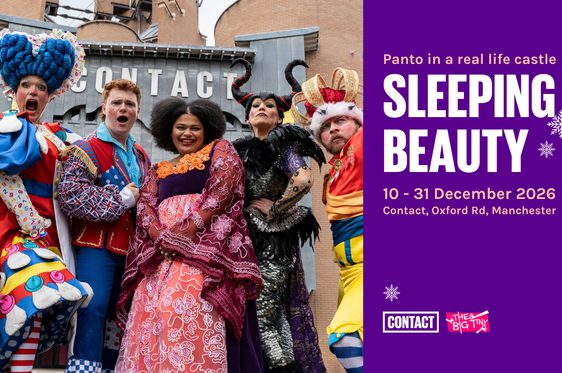
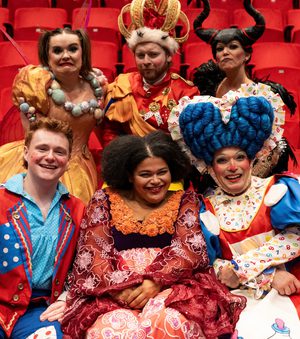
This Christmas, Sleeping Beautyreturns to the pantomime stage at Contact. Working with the award winning Big Tiny, we’re folding our own new twists into centuries of tradition and storytelling. We have local characters like Nanny Ann Coats and local jokes that go far beyond the usual ‘cut and paste’ touring panto. Theres no “lovely to be in (damn, what city are we in this time? Ah yes, that’s it)… lovely to be in Manchester”. But instead, a panto made in Manchester for Manchester (though of course all visitors are very welcome too!)
We interviewed our Writer and Director Ben Richards who said…
“This is Manchester panto and by that I don’t mean that it just takes place in a theatre in Manchester. One of the things we’ve been annoyed about pantos in the past is that they seem a bit cut and paste. In the script, it just says ‘insert name of local town here’. Well, it’s not about Manchester then if you can insert any towns name.
In Sleeping Beauty, the jokes are written for the people of Manchester about Manchester… About those shops over there, about this pub, this community. We’ve got such a rich diverse culture and community, and we are people who want to come together and make art and celebrate Christmas together. I don’t want to make generic cookie cutter pantomime.
We’re going to do our pantomime… a Contact Manchester pantomime!”
So, we hope you’ve enjoyed our peak behind the historic curtain of Sleeping Beauty. And we look forward to welcoming you to our own real-life castle (how many pantos can say that?) for a festive treat that you and all your family and friends can enjoy.
Because in the case of Sleeping Beauty, some stories really can span centuries and live happily ever after.
Author: Rebecca Coughlan, Contact Marketing Manager
All image credits: Rebecca Coughlan (photos of some of the beautiful Sleeping Beauty books we had donated to our free community library).
You might also like …

Announcing the Cast of STARS
26 April 2023Tamasha and ICA announces the cast for Mojisola Adebayo's STARS: an Afrofuturist Space Odyssey.
MIF23 and Contact Present: 50 Hours of Freedom
27 April 2023We’re ecstatic to announce our upcoming partnership with Factory International for Manchester International Festival 2023. In celebration of International Non-Binary People’s Day on 14 July, Contact and Manchester International Festival…
A Note From Our Artistic Director
27 April 2023Read more about Contact's NPO outcome and our plans for the next three years.